Why LLM API Pricing Differs Between Providers
Understanding the Cost of Language Model APIs
When you start building applications with large language models, one of the first things you notice is that pricing varies significantly between providers. A request that costs a few cents with one service might cost several times more with another. This variation can be confusing, especially when you are trying to keep your project affordable. Understanding why these differences exist helps you make smarter choices about where to route your traffic.
What Determines the Price of an API Call
At its core, the price you pay for an LLM API call reflects the cost of running the underlying model. Running a large neural network requires powerful hardware, usually graphics processing units (GPUs) or specialized tensor processing units (TPUs). These chips are expensive to buy and operate. They consume a lot of electricity and generate heat that must be managed. The provider has to pay for data center space, cooling, network infrastructure, and staff to keep everything running.
But the hardware cost is only part of the equation. Providers also invest in the model itself. Training a state-of-the-art language model can cost millions of dollars in computing time alone. Even after training, the model needs ongoing maintenance, updates, and fine-tuning. All of these expenses are factored into the API pricing.
Another major factor is the model's size and complexity. Larger models with more parameters generally produce better results, but they are also more expensive to run. A model with hundreds of billions of parameters requires more memory and processing power per request. Smaller models can be served at a lower cost. Providers that offer a range of model sizes let you balance quality against expense.
Token Pricing and How It Works
Most LLM APIs charge based on the number of tokens processed. A token is a unit of text, roughly four characters in English. Both the input you send and the output the model generates count toward the total. This is called token pricing. Providers set different rates for input tokens and output tokens, because generating text is computationally more demanding than reading it.
When you send a long prompt, you pay for every token in that prompt. If the model produces a long response, you pay for those output tokens too. This means the final cost of a single API call depends on how much text you send and receive. Developers who want to keep costs low often optimize their prompts to be concise and limit the length of generated responses.
Some providers also charge differently depending on the time of day or the current load on their servers. Others offer discounts for higher request volume. The structure of token pricing can vary widely between services, which is one reason you see such a range in prices.
Usage Limits and Request Volume
Another factor that influences pricing is the usage limits each provider sets. Some APIs put a cap on how many requests you can make per minute or per day. Others allow unlimited calls as long as you pay per token. These limits are often tied to the pricing tier you choose. A lower-priced plan might have stricter limits, while a more expensive plan gives you more headroom.
Request volume also matters. If you are making a small number of calls, the per-request price might not matter much. But if your application serves thousands of users, even a small difference in per-token cost can add up quickly. Providers know this and often offer volume discounts. They might lower the per-token rate once you cross a certain threshold of usage. This is common in the industry and can make a big difference for high-traffic applications.
Billing balance and cost monitoring become important when you scale. You need to track how many tokens you are consuming and what your effective rate is. Some providers give you dashboards to monitor your spending in real time. Others send alerts when you approach a budget limit. Without proper monitoring, it is easy to be surprised by a large bill at the end of the month.
Competition and Market Dynamics
The market for LLM APIs is competitive. Many providers offer similar models, so they differentiate themselves partly through pricing. Some aim for the high end, offering premium models with the best performance and charging accordingly. Others focus on affordability, providing access to capable models at lower list prices.
This competition is good for developers. It means you have options. You can choose a provider based on your specific needs. If you need the absolute best quality for a complex task, you might pay more. If you are building a prototype or a low-stakes application, you can pick a cheaper option that still does the job well.
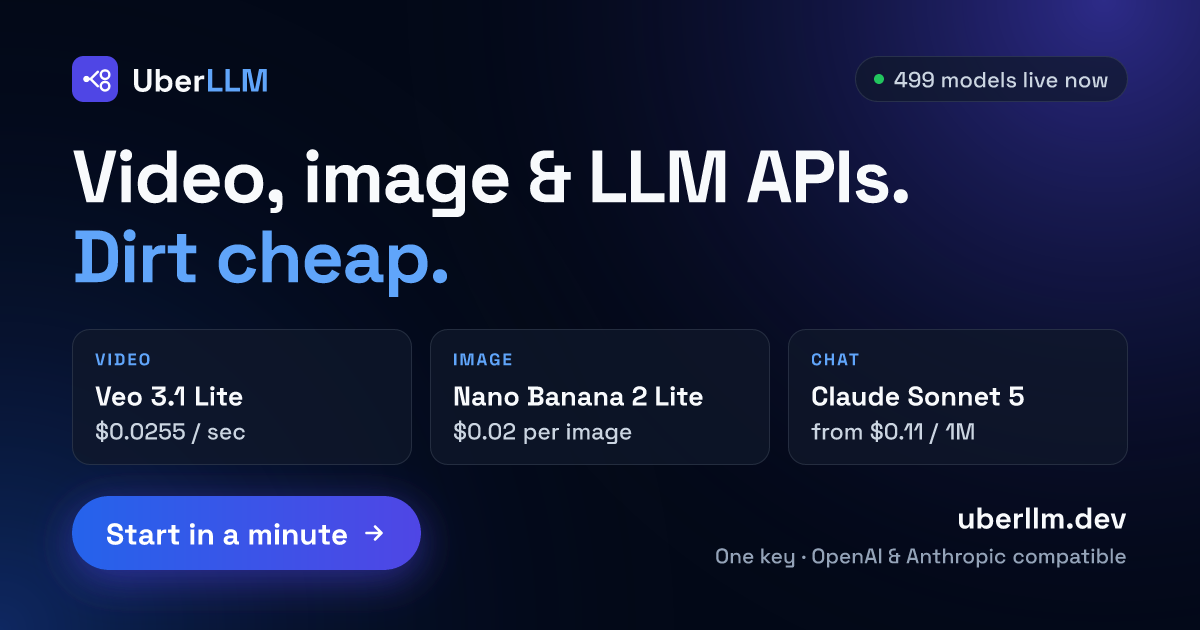
One way the market has evolved is through the emergence of resellers and aggregators. These services buy API access in bulk from major providers and then offer it to developers at a discount. They can do this because they negotiate lower rates based on high volume. This allows you to make AI calls without monthly fees, paying only for what you use at a reduced rate. This model is particularly attractive for startups and small teams that want to keep costs predictable.
What This Means for You
As a developer or product manager, the variation in API prices means you should not just pick the first provider you find. It pays to shop around. Compare the token pricing for the models you plan to use. Look at the usage limits and see if they fit your expected traffic. Consider whether you need a subscription or if you prefer to pay as you go.
Many providers now offer pay-as-you-go pricing with no minimum commitment. This lets you make AI calls without monthly fees and scale your usage up or down as needed. For projects with variable demand, this flexibility is valuable. You avoid paying for capacity you do not use.
Cost monitoring is essential. Set up alerts so you know when your spending is trending higher than expected. Some providers let you set hard caps that stop API calls once a budget is reached. This prevents runaway costs from a bug or an unexpected spike in traffic.
Finally, remember that the cheapest option is not always the best. A low-cost API might have slower response times, lower rate limits, or less reliable uptime. For a production application, reliability matters. Test the service with your actual workload before committing. The right balance between cost and quality depends on your specific use case.
By understanding how token pricing works, what factors influence rates, and how the market is structured, you can make informed decisions. You can choose an LLM API that fits your budget without sacrificing the performance your application needs. The key is to stay curious, compare options, and monitor your usage closely.